
AGM technical documentation – published 19 November 2026 – checked against the 13-page AGM-2840 brochure and the line layout drawing.
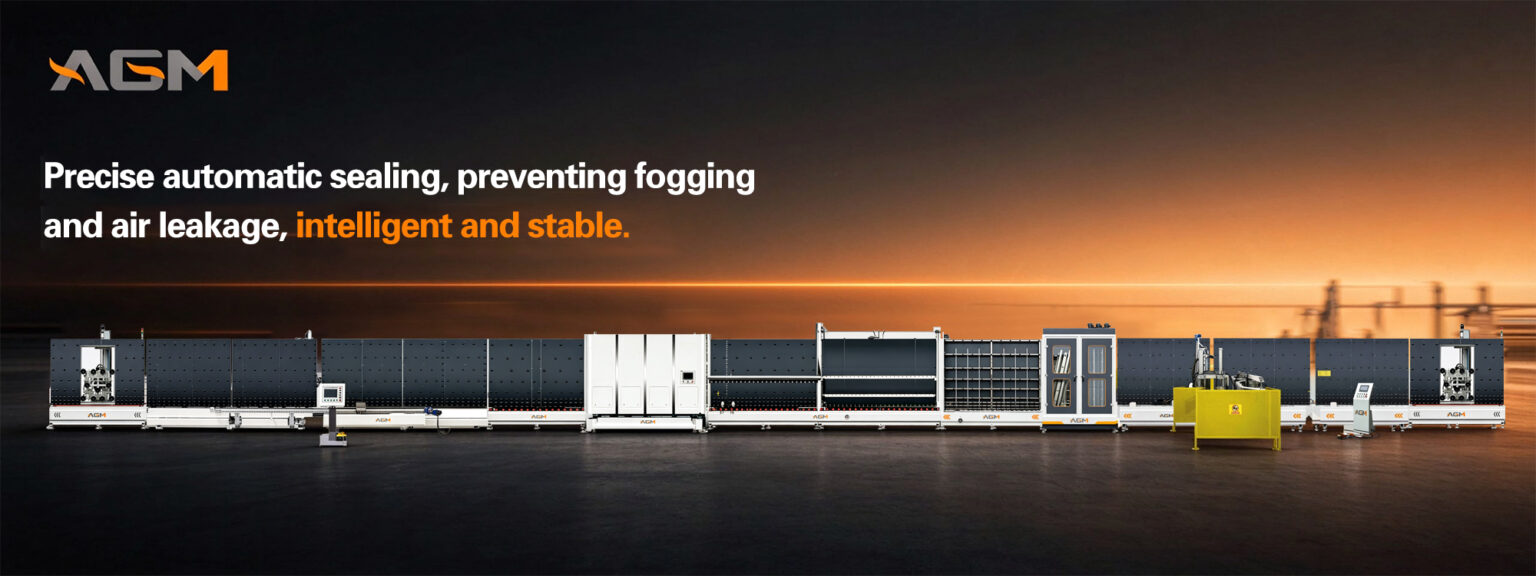
A 2800 x 4000 vertical double glazing production line fails at the plant, not on the datasheet. Hall length, transformer capacity and unit thickness decide whether it runs two shifts or sits idle.
Every figure below comes from the AGM-2840 brochure and its layout drawing, so each one can be checked against the documents. The two that matter most are the 40 mm unit limit and the hall length.
What the AGM-2840 is
The AGM-2840 is a vertical double glazing production line that washes, assembles, presses and seals insulating glass units from 400 x 500 mm up to 2800 x 4000 mm.
The line runs right to left. Panels are carried at a 550 mm pass height, and the conveyor is rated at 130 kg per metre, so check that figure against your heaviest unit before lifting equipment is specified. Glass enters at 3 to 12 mm; the finished unit leaves at up to 40 mm.
Cleaning is automatic external plate flushing, four stages, at 2 to 12 m per minute, with a maximum travel speed of 45 m per minute. The press is servo driven. Sealing is handled by the AGM-2800-31/32 line in the same package, which is fully automatic and supports double and triple units.
The 40 mm unit limit decides your product range
A 40 mm unit thickness limit, not the 2800 x 4000 mm panel limit, is what usually rules this line in or out. Panel size is easy to see on a brochure; unit build-up is not.
A triple unit built as 4 + 16 + 4 + 16 + 4 mm reaches 44 mm. That is outside the 40 mm figure on the AGM-2840 page, and it is a common European triple build. Run your own mix through the same arithmetic before you compare prices.
There is a second number to reconcile. The sealing line in the same package is listed at 12 to 60 mm unit thickness, while the washing and pressing group is listed at up to 40 mm. If your order book sits between 40 and 60 mm, ask in writing how the press group is specified for that range.
Hall length: what the layout drawing adds up to
The layout drawing supplied with this line runs from the automatic unloading section to the automatic loading section. Its twelve printed section lengths add up to roughly 47,000 mm.
| Section as labelled on the drawing | Length (mm) |
|---|---|
| Automatic unloading section | 4800 |
| Loading section | 3100 |
| Second section | 3100 |
| First section | 4300 |
| Unloading section | 4000 |
| Press section | 4550 |
| Outer assembly section | 4200 |
| Frame loading section | 4250 |
| Transfer section | 4000 |
| Washing section | 2500 |
| Loading section | 4000 |
| Automatic loading section | 4200 |
| Total of printed sections | 47000 |
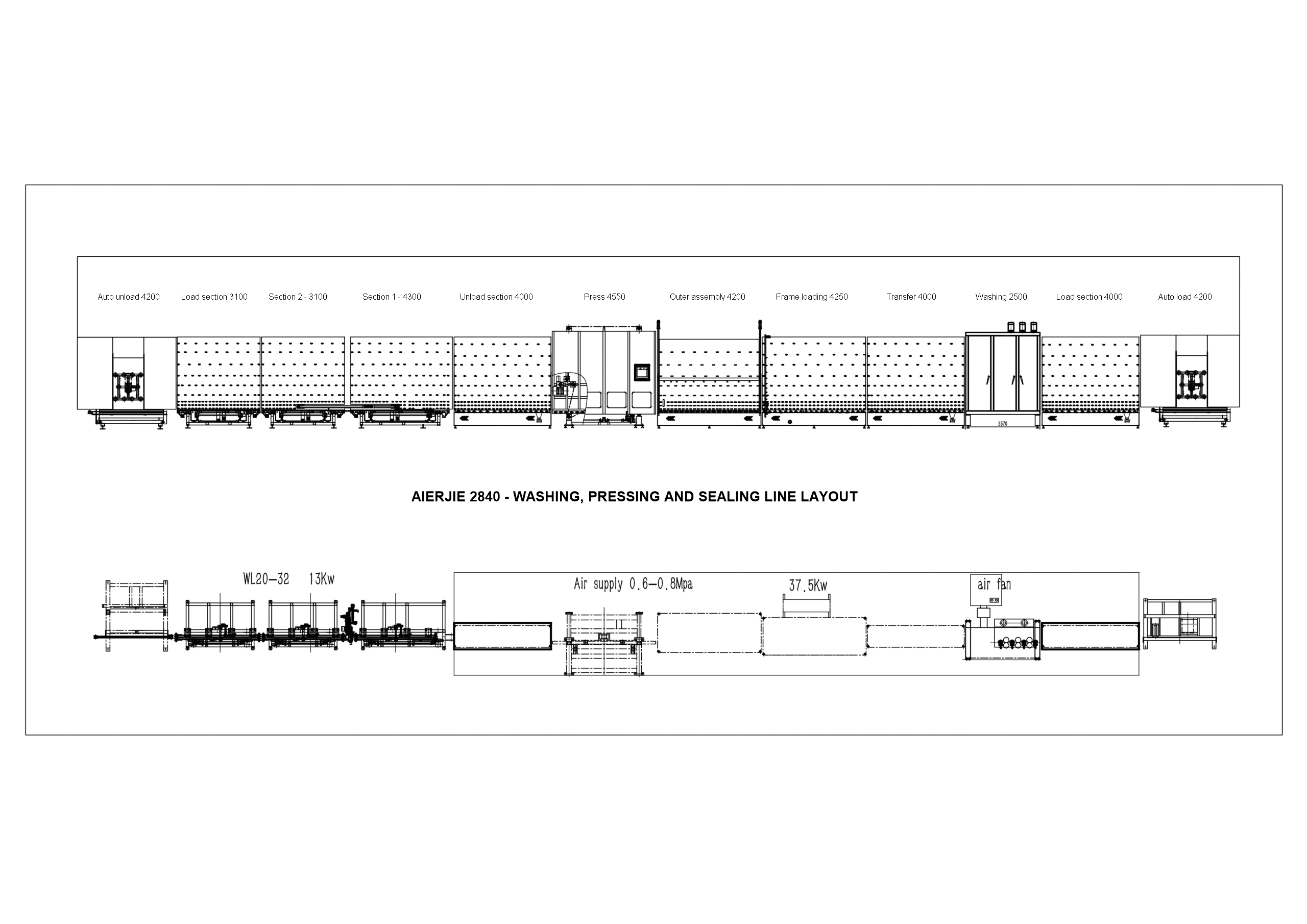
Treat 47 m as clear hall length before walkways, glass racks and the operator aisle. The brochure separately quotes 27,000 x 3,000 x 3,950 mm for the machine group, so ask which sections that figure covers before you draw the floor.
Section labels above are translated from the Chinese annotations on the drawing. Confirm them against the final assembly drawing, which is also the document your builder should see.
Utilities to have ready before the container lands
The AGM-2840 draws 21.6 kW at 3-phase 380 V 50 Hz, needs 1.2 cubic metres per minute of compressed air, and uses circulating water held under 40 microsiemens.
| Utility | Figure on the datasheet | What to check on site |
|---|---|---|
| Power | 21.6 kW, 3P 380 V 50 Hz | Transformer headroom with the compressor and lighting running |
| Compressed air | 0.5 to 1.0 MPa, 1.2 m3/min | Dryer and receiver sized for continuous flow, not peak |
| Water | Circulating, 0.5 t per day, conductivity at or below 40 uS | Water treatment if your mains runs harder than that |
| Pass height | 550 mm | Floor level and pit, if any, at the loading end |
| Load | 130 kg per metre | Rack and trolley rating at both ends of the line |
The 21.6 kW total includes an 18.5 kW high-pressure blower in the drying section. That single motor is most of the electrical load, so a supply sized for the headline number with nothing to spare is a supply sized too tight.
Compressed air is the utility buyers most often under-provision. The datasheet figure is a flow rate, which assumes the dryer, filter and receiver can hold it while the press and the sealing line cycle together.
The mismatch to catch: 2840 line, 2535 loaders
The AGM-2840 processes panels to 2800 x 4000 mm, while the standard automatic loading and unloading units in the same package are rated to 2500 x 3500 mm.
| Module | Model | Max panel | Note |
|---|---|---|---|
| Washing and pressing group | AGM-2840 | 2800 x 4000 mm | Main line spec |
| Sealant application line | AGM-2800-31/32 | 2800 x 4000 mm | Supports double and triple |
| Automatic loading machine | LSJ 2535 | 2500 x 3500 mm | Standard unit in package |
| Automatic unloading machine | AGM 2535 | 2500 x 3500 mm | Standard unit in package |
| Aluminium frame bending machine | AG-ZWJ01 | Frames to 2000 x 2000 mm | Frame size, not panel size |
If 2800 x 4000 mm panels are part of your order book, put that size in writing and have each module confirmed against it. A line rated for a panel that its loaders cannot lift is a line that runs at 2500 x 3500 in practice.
Frame making has the same shape of problem. The bender is listed for frames up to 2000 x 2000 mm, so a 2800 x 4000 mm unit needs frame handling confirmed separately, whether that means a larger bender or a bought-in frame.
Gas fill: 3 to 5 seconds per unit
The optional in-line gas fill detects unit size, calculates a 3 to 5 second filling time, and states a gas concentration above 85 percent for both double and triple units.
| Gas fill point | Figure on the datasheet |
|---|---|
| Fill cycle | 3 to 5 seconds, set automatically from panel size |
| Stated concentration | Above 85 percent |
| Unit types | Double and triple glazing |
| Drive | Four ball screws, servo timing belt |
Fill cycle and concentration are quoted at the machine. What your customer tests is the concentration inside a sealed unit after handling and transport, which is a different measurement. Ask how the fill nozzle seals, and whether the press closes on the same station.
Components that set your maintenance bill
Serviceable parts decide what year five costs. The brand list is therefore a purchasing document, not a decoration.
| Module | Component | Brand | Origin |
|---|---|---|---|
| Washing group | PLC | Panasonic | Japan |
| Washing group | Low-voltage electrical | Schneider | France |
| Washing group | Photoelectric switch, relay | Omron | Japan |
| Washing group | Solenoid valve, pressure reducing valve | Airtac | Taiwan, China |
| Washing group | Linear guide and bearing | Taijing | South Korea |
| Sealing line | Servo motor, motion control, servo drive | Yaskawa | Japan |
| Sealing line | Inverter | Inovance | China |
| Sealing line | Touch screen | Weilong | Taiwan, China |
Two practical readings. First, Panasonic and Yaskawa parts are usually available locally in most industrial markets, which shortens a breakdown. Second, mixed sourcing means two spare-part channels rather than one, so ask for the recommended spares list by module.
Five checks before you sign
- Unit thickness against 40 mm. Write your thickest build as glass + spacer + glass and compare.
- Loader and unloader rating against your largest panel, not the line’s largest.
- Hall length from the layout drawing, plus walkways and rack space.
- Transformer, air receiver and water treatment sized for the whole plant, not the line alone.
- Gas fill: how concentration is verified after the unit is sealed.
Print the list, take it to the site visit, and put the answers in the purchase order. None of the five needs a technical background to check.
FAQ
What is a vertical double glazing production line?
A vertical double glazing production line is a set of machines that builds insulating glass with the pane standing upright, so washing, assembly, pressing and sealing run along a vertical conveyor instead of a horizontal table.
What glass thickness can the AGM-2840 process?
The AGM-2840 takes single glass from 3 to 12 mm and produces finished units up to 40 mm thick, with panels from 400 x 500 mm to 2800 x 4000 mm.
How much space does a 2800 x 4000 insulating glass line need?
Plan on roughly 47 m of clear hall length for the full run described in the layout drawing, before walkways and glass storage. Confirm the final figure against the assembly drawing.
Does the AGM-2840 fill argon automatically?
Yes, as an option. The in-line unit reads the panel size, sets a 3 to 5 second fill cycle, and states a concentration above 85 percent for double and triple units.
Key takeaways
- A 40 mm unit limit rules out common 16 mm-cavity triple builds, so check your thickest product before comparing line prices.
- The layout drawing adds up to roughly 47 m of hall length; the 27,000 mm brochure dimension is not the whole run.
- The line takes 2800 x 4000 mm panels, but the standard loaders in the package are rated to 2500 x 3500 mm.
- 21.6 kW, 1.2 m3/min of air and water under 40 microsiemens are plant conditions, not line options.
If you send your glass mix, daily panel count and a hall drawing, the fit can be confirmed module by module before a quotation is issued: kevin@ierjie.com. Machine range and company background are on www.algerglass.com.
About the documents behind this page
Two documents were used: the 13-page AGM-2840 brochure and the line layout drawing supplied with it. Every figure on this page is taken from one of them, so a buyer can check each claim without asking for anything extra.
The brochure header carries CE and ISO 9001 marks. Certificate numbers are not reproduced here, and none are claimed on this page. The same brochure states more than 20 years of experience in insulating glass production.
Contact for technical questions: kevin@ierjie.com, +86 182 4172 0055, www.algerglass.com.